


 Melbourne BG SCS Train Timetable


Abashiri, Hokkaido – April, 2023
After failing to find freight in Engaru and checking out station ruins in Yubetsu, I proceeded through Kitami to Abashiri. There are quite a few limited express trains between Engaru and Kitami, but I chose an old rattler. It didn't disappoint!
The other good thing was that the local service had to wait for all other express services to pass.
At Kitami I saw the 'on-road' freight terminal, with no freight trains... as expected.
But the station area was very well looked after.
Instead I used the local bus to check out the local Hard Off. It didn't disappoint, finding a cheaply-priced random set of Marklin Z-Scale Coca-Cola Liveried DB passenger cars.
I even then had enough time to catch the bus back and the Taisetsu to Abashiri. Look at the engineer, happily standing in the vestibule looking out the front window. We used to be able to do that!
Before-long I was in the town of a very famous jail, but I didn't visit it. Instead I just saw a train, locked up.
Abashiri is the end of the line for the express trains and therefore has quite a nice yard with sheds to keep the diesel engines warm in the winter months. Actually, the summer months too as there was still remnants of snow on the ground.
From the north side of the station, you can walk into (and through) the carpark to get to a pedestrian level crossing which has a great viewpoint in both directions along the rail.
One can only assume that there's been a few incidents at the crossing.
Don't be one of them.
Katsuradai Station
From Abashiri, There's a local service around the eastern coast and through the mountains to Kushiro. I had enough time to spare, so I wandered from Abashiri Station to Katsuradai Station, the next along the line to the east.
Along the walk you can see where they've 'recently' elevated the line to get rid of a few level crossings. There's also random interesting junk lying around...
Before long, I was at Katsuradai Station, waiting for a service to come through.
There's a bridge just to the north of the station which provides a great viewpoint in both directions.
And more random junk...
And then it pissed down... right when the southbound train was due. Through the rain, whilst hiding under the nearest tree, I could hear 'urgent'-sounding announcenments from the station speaker. Once the rain stopped, I walked back to the station to listen more-clearly.
I couldn't understand it all, but it didn't sound good... so I checked the website.
Oh right, it got progressively worse as I kept refreshing the page...
All services cancelled! I needed to take this line the next day!
I walked back along the line, but then continued into town. There's a beautiful bus depot in the middle with a vintage shell petrol station embedded.
The rest of the day was spent dawdling around the yard watching trains come and go... and being scared of the weather.
I asked at the station if the line to Kushiro would re-open the next morning and was told that it would. Everything would be fixed overnight.
Shiretoko-Shari Station
I got up early enough to have a plan-B... but the plan wasn't sound. I could either take the Taisetsu/Ohotsk back to Asahikawa and then Sapporo, or attempt my circumnavigation of the rails and try and go clockwise on the local service via Kushiro. The issue was that the anti-clockwise express left first, so if I chose not to ride it AND the local to Kushiro failed, I would then be totally stuck.
I checked the JR Hokkaido site when I got up and gambled on the Kushiro service. I could see that the local to Kushiro was waiting, humming nicely, on the platform.
I watched them kick-over and extract the express from the shed. It has to traverse the previously-mentioned level crossing a few times, so it's great to view in the morning sun.
Watching the other stock kick-over was also a delight. Before-long my only hope had left for Asahikawa... And other diesels were brought in for other services.
I was left to ride my jellyfish/potato-express.
Pretty hilarious, as this is the DMU I wanted a photo of the night before. Anyway, we were on our way and the scenery was fantastic.
Before-long, we were at Shiretoko-Shari Station. The opposing train came in (single-line-working ahead), but I saw that the station master had donned his hi-viz and was discussing problems with our driver.
The northbound service left us in its dust and we were left on the phone to JR Hokkaido asking them to fix the signals. The station master did a great job communicating this to the 6 passengers on the train. 4 Foreigners and an ederly Japanese couple. The latter had to get to a hospital in Kushiro and the rest had to get through to Sapporo.
I checked the website whilst the station master was still trying to work out if we could proceed and found out that JR Hokkaido had already put a stop to that... that first 06:41 line was my train!
Around 20 minutes later, a local taxi driver had been summoned and we were bolting down the highway. Sometimes it was 120km/h in a 50-zone... other times it was 40-in-40 when it was obvious that speeding wasn't warranted.
We followed the line for a while, but then veered further west, taking a path off the highway to Kushiro.
And then... finally some freight!
And then... the cost. Thanks JR Hokkaido!
We actually made it to Kushiro faster than if we'd travelled by train, but not totally unsurprising. Last time I was here, I'd wanted to visit the model railway store in front of the station, so I did just that.
I giggled in excitement when I saw the prices in that last display cabinet... but the shop owner was watching and quickly told me that was the museum case and everything was display-only. The prices were as-they-were back in the 70/80s. Oh well.
I went to get the same curry I did last time in the station building, but that shop had closed for good.
Instead I found something similar a few shops down the corridor. Finally, it was a waiting game for the express to Minami-Chitose.
Much cleaner than the last Ozora in 2019... and again no access to the front window.
After that it was a quick trip to Minami-Chitose and then the airport.
Whilst transferring, I quickly checked out the outlet malls... but every second shop had closed down! Bloody covid.
Yubetsu, Hokkaido – April, 2023
So, look... I was sad... there would be no freight in Hokkaido this time around! I found this out at ~8pm on a Sunday night and entered what-else-shall-we-do mode, scanning google maps for targets. Engaru was intially a junction for the line out to Yubetsu and, although the line no longer exists, there're still a few remnants to visit! Having the next day being Monday also meant that the bus services were actually quite frequent!
I got up at sparrow's-fart and left my crap in the Hotel room. To my surpise, I was presented with a warm sunny morning, after it'd been horizontally snowing the night before! I was also happy to find a bus terminal on the doorstep, but the bus wasn't for another 30 minutes. Instead, I dawdled to 7-11 and grabbed the day's essentials.
There is no purchasing of tickets from the station. Instead you grab a ticket from the machine as you enter the rear-door of the bus.
Around 8 stops later, match the number on your ticket toe fare listed on the board above the driver and pay the corresponding amount. From there, the bus will continue on it's way...
And you'll be presetend with Yubetsu Station, as it was... Or is it? There seems to be electrical caternary guards under that pedestrian overpass? Was it donated?
The YOs have been doubled-up and turned into classrooms, but they don't seem to have been used recently. I initally thought they were larger vehicles until I saw the welded footplates.
The whole park is beautifully designed and used as a road-stop. There's also a Tulip museum!
I caught the next bus back to Engaru, with the plan to check out and head to Abashiri via Kitami.
And the best part, a JNR KIHA was waiting for me!
Engaru, Hokkaido – April, 2023
After making it to the northern and eastern extremities of Hokkaido back in 2019 (pre-covid!), I'd decided I wanted to do the round-trip via Abashiri. There's freight to see on the line from Asahikawa, via Engaru, to Kitami and a joyful train from Abashiri to Kushiro. Getting there would be no mean feat though!
The plan was to get to Asahikawa and then venture east. From Shin-Osaka, it would've been a 2-day trip via trains, and I'd done that last time. This time I was to cheat and fly Itami(Osaka) to Chitose(Sapporo), leaving very little time to transfer to the Limited Express trains.
Getting to Sapporo via Itami
The first leg was easy.. and this may even be the first time I've featured a plane on this blog. JAL has a Japan Explorer Pass and, even though I didn't fly JAL into Japan, any international visitor can still make use of it inside Japan, as long as you prove to have a booking reference for an international flight. You simply provide that information whilst booking. It's very similar to the Japan Rail Pass, which I was about to activate.
I'd never been to Itami Airport before, but it was an easy trip on the Hankyu Railway, with a transfer to the Osaka Monorail at Hotarugaike Station. Note that the monorail makes a huge S-bend at this station and it'd be great to photograph... when one isn't rushing to a plane. Getting to the Hankyu line involved a 5am walk through Nishinakajima-Minamigata... it was very serene.
Before long, a westbound local took me to Juso where I changed for a northbound service. It happened to be the first out of Umeda for the morning and the karaoke experts were all sleeping on the seats, just itching to get home to their warm beds.
Itami was a very non-eventful event. There was a huge queue to check in and so I tried to use the check-in kiosks. It couldn't work out my english name and, before I could press the 'call attendant' button, a staff member grabbed me and coerced me to the 'priority' desk. Hah. I felt sorry for the other passengers in the queue!
All checked in, with my bag still in hand (I had no time to wait for checked-in baggage at the other end), I headed into the airport's main terminal. It's... stunning!
I watched a lot of cargo get loaded... and other people's luggage...
And then we were off! Landing 5 minutes early.
Sapporo to Engaru
Despite being at the far northern end of Japan, the Limited Express trains in Hokkaido are still convenient and fast. Sometime in the future there'll be shinkansen, but it'll still only reach as far as Otaru, via Sapporo City. Getting further north will still require the use of zairaisen.
We arrived at Sapporo New Chitose Airport early and this meant I could make the 10:06 rapid to Sapporo. I could then take the Lilac 13 express north, arriving at Asahikawa in time for the first Taisetsu of the day! If I was a few minutes later, I'd have to take the ~2pm Lilac 17 from Sapporo and then a Rapid Kitami, getting to Engaru 2 hours later. Two more hours of daylight in my target destination was definitely a bonus! Maybe even an extra freight service.
The trip out to Sapporo was nice, being in the front behind the driver. I love being able to see the tracks ahead... but not the mountain-tops... isn't this meant to be the end of Spring?
Lucky I'd packed for winter. Sapporo Station was even still ready for winter:
Yup, those heaters were active.
Asahikawa
Lilac 13 departed on time and we were on our way to Asahikawa. They've blocked access to the corridor which leads to the front window of these trains. It happened years ago, but it's still sad that there's no more ability to see through to the front.
Taisetsu (the name means 'heavy snow', I'd initially thought 'important') was there waiting... and the weather was dreary! It got furtherly-hilarious along the way...
But then we cleared the mountain range and the snow went from blizzard to spring.
And, before long, we were in Engaru... the first stop for freight!
Engaru
This small town has a lot of railway history. The line used to extend north-east to Yubetsu, but now there's just a few relics along the old alignment. I didn't have transport, so instead loitered in town waiting for the trains to pass in and out. They don't officially pass 'through' though, as the station functions as a switch-back terminus.
It was bloody cold and there were signs of recent snow activity...
I climbed the pedestrian bridge where the incoming rails split north and south. Fortunately, there was another railfan waiting! The freight must be coming!?...
Not freight, but a darn fine KIHA40 in JNR Vermillion. Turns out all of the KIHAs up here have been painted in koku-tetsu (Old-skool JNR) liveries and that's what everyone's hanging out for. Speaking of hanging out, the freight never came... so I checked out the SL Park.
To the north-west of the station is a rock formation with a lookout up the top. The SL Park is down the bottom and there's even a public toilet. Can you just imagine how majestic the area would've been when the SLs were operational? Needing to be turned to pull the freight back out of Engaru yard? Anyway, thinking of that made me go back to the station and dawdle around... taking photos of random stuff ...
I'd arrived in time for the ~2pm freight, but that didn't happen. I then dawdled further until the ~4pm freight... but there was no sign of that either.
You can only take so many photos of Vermillion, right? Anyway, the next train wasn't until 8pm, so I went and checked into my Hotel Sun Shine.
After a quick relax... I found random combini dinner and then trotted back to the station for the evening freight. Actually, on the way to dinner I checked out the snow plow at the end of the yard.
Very cute... but I prefer a DD51 with plow carriages. Anyway, dinner.. then the station... and more KIHAs.
SO PRETTY. I then loitered...
Note that the departure boards are all fixed-lighting and they switch in the service departing from the platform. Very cool.
Then the expresses came through. They were meant to pass further south, but the northbound was delayed and the pass happened in front of me!
They both left... A KIHA was hanging around... so I photographed it...
And then the station-master came out and asked if I was waiting for the freight. I could feel the bad news coming.... He proceeded to explain that the "tama-negi" season was already over. I then asked if that's the only rail-freight on this line and he very simply said 'yes'. I was slightly astonished... they run two daily return trips to Kitami JUST for brown onions!
And just to rant... in English, "onion" is brown onion and "spring onion" is just that. In Japanese "negi" (onion) is actually spring onion and "tama-negi" (ball onion) is brown onion. Amazing how we have the single-word version backwards. Anyway, I digress... the whole bloody point of this trip was that I'd seen the paths on the timetable and thought it would be fantastical to see the freight operating. Supposedly I'd missed them by one week. Super Mario 2 had plucked the last onion around 10 days earlier and it'd already been boxed and railed.
It started snowing. I went to bed. I still wanted to complete the loop of Hokkaido and ... well ... now that there was no freight in Kitami, I could go to Hard Off :)
Oh! The pedestrian overpass did have graffiti.. I was a little surpised.
Appropriate? Maybe another tecchan also missed out.
Twilight Express Mizukaze – Virtual Railfan
Whilst still stuck on the wrong side of the globe, having to watch borders closing again thanks to new variants, I decided I'd make the most of the plethora of live cameras popping up in Japan to chase the Twilight Express Mizukaze on one of it's current round-trips. It's actually really sad to think that I first virtually chased this in 2017, saw it in 2019 and then haven't been able to go back since!
But enough of the whining, we're here to chase it virtually. The official journey starts at Shin-Osaka Station, but since the consist is stored in the yards just south-west, there is no direct route to the platform it's meant to pick up passengers on. Instead, it runs a huge loop via Osaka Station! This is a bonus for us as it means it passes more cameras.
Shin-Osaka: Dead-head to Kyoto
As mentioned, the train has already done a loop via Osaka Station and can be first seen exiting Shin-Osaka Station at 0933, heading north on the Shin-Osaka Webcam.
Mukomachi: Dead-head to Kyoto
Instead of turning at Suita, or even at Mukomachi?, they run the service all the way to Kyoto! Is this some kind of shake-out? It passed the Mukomachi camera at 0952 heading north.
Kyoto Station: Dead-head back and forth
Thanks to the Kyoto camera just to the east of the station, it's easy to watch it bounce back and forth. Here it is passing at 1010...
And then back again at 1023...
Mukomachi: Dead-head to Shin-Osaka Station
The goal is to arrive at Shin-Osaka at 1114, for a 1147 departure. The train is seen passing back past the Mukomachi camera at 1032.
Arriving at Shin-Osaka for departure
Finally, the train is seen on the Shin-Osaka Webcam one more, arriving back in to Shin-Osaka Station at 1113 on the correct platform.
Nishinomiya
Another user has set up a webcam in Nishinomiya and the train can be seen passing at 1202.
Base of the Akashi-Kaikyo Bridge
There's some amazing cameras mounted on one of the supporting piers of the bridge to Shikoku. At least one of these point towards the railway and the train is seen passing at 1225.
Okayama (x3)
The train's route is quite random this time around... it passes Okayama to Nakashou, goes back to Seto via Okayama, then westbound once more to Kurashiki. It therefore passes the Niwase webcam three times! Here it is on the way to Nakasho at 1432...
And then back to Seto @ 1550...
And then back to Kurashiki @ 1733...
Unfortunately the Okayama Freight Terminal webcam is offline. There was also the meant to be a camera overlooking construction at Hiroshima Station, but that's now changed to a view over Kure Port and Pachinko Parlours.
Amarube Viaduct
I haven't been able to find any other webcams for the train's western leg, so its Day Two journey around Matsue and Shinji will be if-a-tree-falls-in-the-woods style. Fortunately, on Day 3 it passes the Amarube Viaduct at around lunch time. The viaduct's camera is some kind of older security camera and only produces singular frames. Fortunately it does refresh relatively quickly! I wrote a bit of code to continuously poll the image, check if there's a difference and then save the files. From here, I then filtered out the boring parts and turned the rest into an animated gif.
Above you'll see some beautifully-orange KIHA 40s running the local services, tour buses delivering hoards of ants, KIHA 189s running the Hamakaze and then finally the KIHA 87 Twilight Express Mizukaze bolting through, heading east.
Back via Kyoto
After meandering back through Fukuchiyama and Funaoka, the train passes the Kyoto Railway Museum and arrived into Kyoto Station. Thanks to the Kyoto Camera, we get it heading in...
And then heading back out on its final leg to Shin-Osaka...
And then, via the Mukomachi camera...
And finally back via the Shin-Osaka Webcam...
1952 Tokyo Railway Map
Next up from the box'o'paraphernalia, a map of Tokyo Railways from Charles E. Tuttle Company. This seems to have been produced in 1952!
The map is usually folded into a single pane, but I stretched it out for that first scan above. Mainly so you can see the penciled in 25c price tag up top-right. I don't even remember where I acquired this from, but I'm sure I paid more than that.
Note that the pop-up doesn't show the image in the best quality... use this high-res version instead.
The shot above is a stitched-together image from 9 A4 scans. I used Hugin to do the stitching, using the tutorial here. '10' is the magic number for focal length and it did a pretty magic job!
The Royal Express Visits Hokkaido (Again)
It's been a while, and there's a lot to post, but for now I'm catching up on trains. Actually, this isn't catching up at all... this train is touring Hokkaido as we speak. The Royal Express is a ridiculously beautiful electric set train that runs (usually) from Yokohama to Izu-Shimoda on the Izu Peninsula, but, due to Tokyu Corporation being perfectly adventurous, is running on non-electrified lines in Hokkaido!
It's an ELECTRIC TRAIN! You say? There's very few overhead wires in Hokkaido, you exclaim!? You'd be correct! To run this tour, they have employed two freshly-painted DE15 locomotives and a mail-car-come-generator-car painted in white, to (literally) tow the electric train through the beautiful pastures of Hokkaido.
Thanks to the current world order: we can't travel from Australia to Japan, but thankfully we can watch! Japan has a fantastic acclimation to rail-side webcams and a hotel in Obihiro has actually mounted one on their building with a perfect view of the station. The same team have also provided views of the airport and a famous bridge. Note that these links change all the time, so please just browse to their channel to find what they're offering!
Anyway, where was I? Oh yeah.. the tour train has actually already operated this route twice this season. Thanks to lockdown, I haven't been in any correct frame to be alert to its movements. Or maybe I was just working? The train passes the Obihiro Station webcam just after 4pm Australian Eastern Time and, well, it's knock-off for anyone starting on-or-prior to 8am.
Fortunately, I set my alarm today and caught it!
So yeah, double-DE15 + white power van + Royal Express EMU. Who would've ever thought to tow an EMU on 'genny'-power with two very light-weight diesels!? It's actually amazing on a many levels: reliability, engine-weight, loading-gauge... the list goes on.
Anyway, for those playing at home, Obihiro Station is a major freight-accepting town (the yard is further to the left/west of the camera), but has single-lines on either side. This means that, if you see a train, regardless as to whether it's meant to actually stop at Obihiro, it'll at least pause on the camera as there's line-working preventing it from proceeding. There are freight, Limited Express Tokachis (to the west) and Limited Express Oozoras (both directions) on the line at all times and there's always another service to wait for.
So yeah, it waited... and the westbound Oozora from Kushiro arrived.
Not long after, The Royal Express departed for Ikeda and the Oozora went onwards to Sapporo. From here it'll do a full loop, turning north at Kushiro (I want to do that next!) to Kitami and then back through Asahikawa. When this current world situation is over, I'll be doing the same!
Update: 04/09/2021
The Express De Royale has left on another lap, in delicious sunshine:
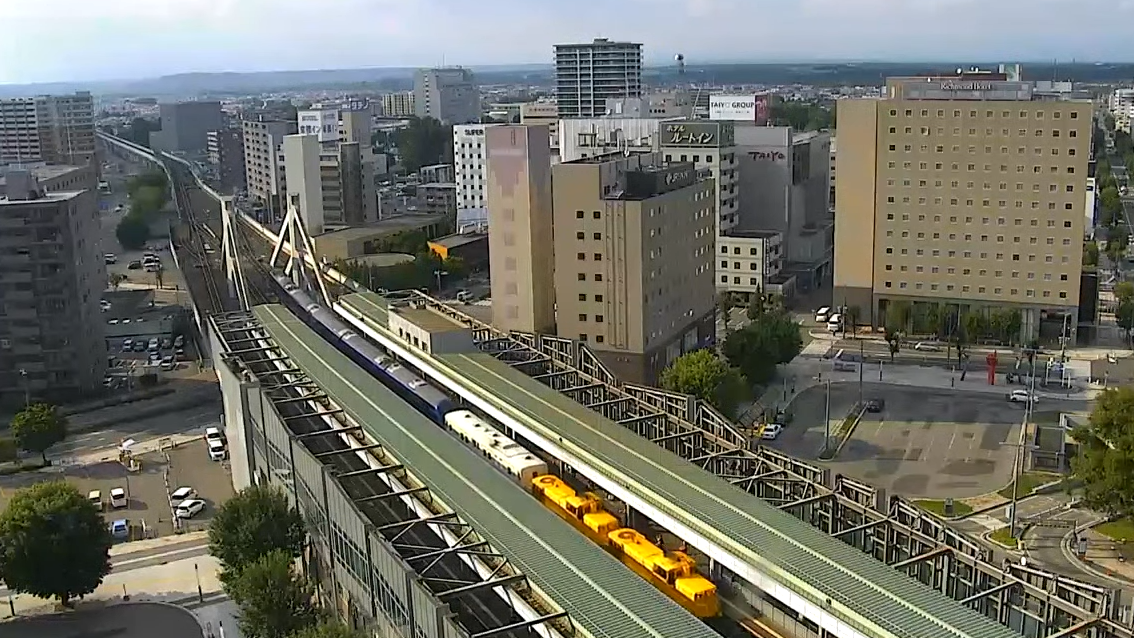
Enjoy patrons, enjoy.
Kangaroo Liner でGO!
2021's Timetable Revision is full of more surprises! First we had the innauguration of the new Fukuyama Rail Express from Ajikawaguchi to Morioka. Next up we have a new service known as the Kangaroo Liner, run by the Seino Group, from Nagoya to Fukuoka! The train is named after the companies' logo. Something quite similar to QANTAS, but backwards.
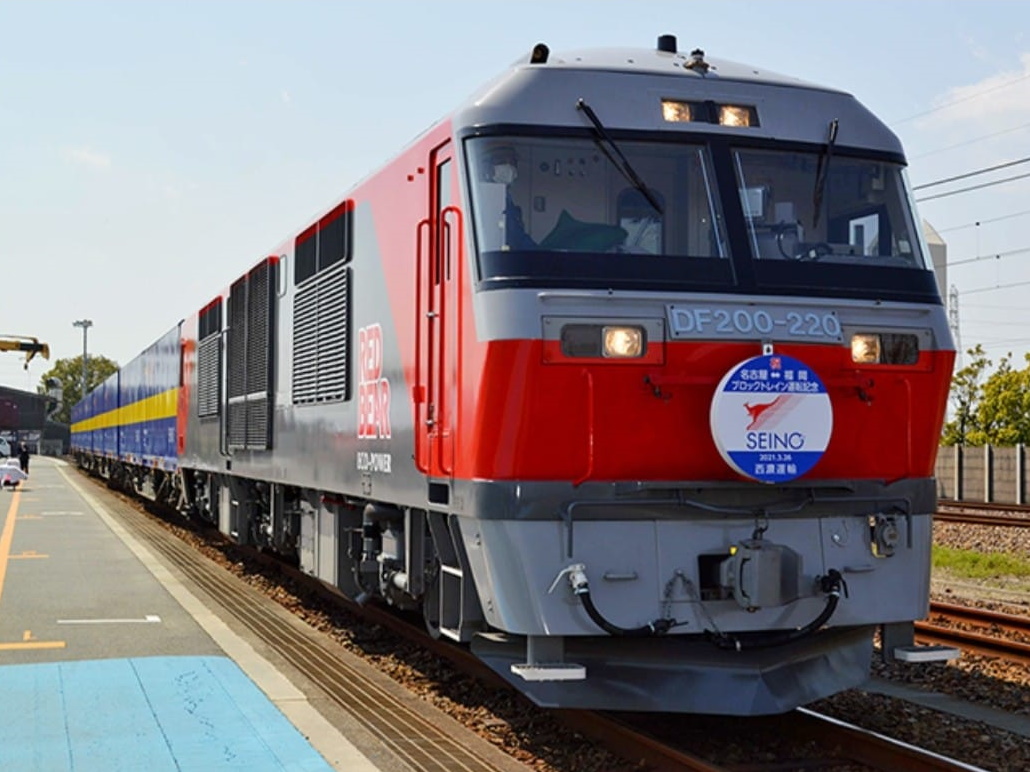
Above is the stock image that was sent out with all media online. I was very surprised to see a DF200 up-front... so-much-so that I thought there'd be a chance one would run the service! The media releases indicated that the train wouldn't be full of Kangaroo-only containers and that there'd be space available for other operators to hitch a ride.
| Location | Northbound | Southbound (read upwards) |
|---|---|---|
| Service | 5051 | |
| Nagoya Terminal | 2212 | 1823 |
| Inazawa | 2229-2237 | 1721-1804 |
| Gifu | 2258-0007 | 1559-1655 |
| Suita | 0201-0204 | 1245-1250 |
| Kobe | 0238 | 1210 |
| Himeji | 0309 | 1135 |
| Okayama | 0423-0432 | 0911-0957 |
| Hiroshima | 0646-0649 | 0554-0601 |
| Iwakuni | 0734 | |
| Shinanyo | 0850 | 0409 |
| Hatabu | 1028-1040 | 0219-0244 |
| Kita-kyushu | 1056-1106 | 0125-0202 |
| Fukuoka Terminal | 1247 | 0022 |
| Service | 5050 |
Westbound Service
The first train to leave was the westbound service from Nagoya to Fukuoka. At 2012 on March the 29th, the service departed and passed the Nagoya Station Camera not long after.
As you're watching the start of the video, you might be ready to tell me that it's "not the right train!"... but as the consist keeps rolling through the camera, you'll see that the Kangaroo-liveried containers are all piled on the rear. As mentioned above, there was always going to be spare room on the rake of flat wagons and the company was very happy to accommodate other operator's containers.
After travelling west, it then passed the Mukomachi Live Cam with quite a few more Kangaroo containers on-board!
From here, the Shin-Osaka cam picked it up, but it there was less-than-zero visibility. Unfortunately, there's no other cameras to the west to capture the action!
Eastbound Service
Due to this limited visibility out west, the first spot the train was seen was the Shin-Osaka Live Cam. The eastbound service seems to have at-least half a loading of Kanga-tainers.
After a stop-over at Suita, the train passed the Mukomachi Live Cam on time.
And then finally, back through the Nagoya Station Camera.
Looking forward to seeing these in real life... at some point... in the distant future.
Fukuyama Rail Express でGO!
The Fukuyama Rail Express is an express rail-freight service run by Fukuyama Transporting Co, Ltd. Regarding rail-freight, they previously only operated a service from East-Fukuyama to Tokyo.
Here's a shot of that service from my travels in 2019, running past Shin-Osaka Station behind an EF66.
As of yesterday, a new service has been innaugurated from Ajikawaguchi (Osaka) to Morioka!
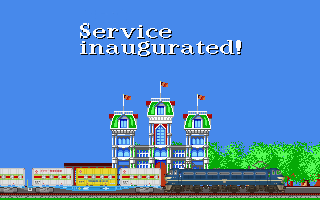
How bad is my photoshop? Note that the services only run on weekdays.
| Location | Northbound | Southbound (read upwards) |
|---|---|---|
| Service | 58 | |
| Ajikawaguchi | 2208 | 1600 |
| Suita | 2227-2231 | 1516-1528 |
| Gifu | 0023 | 1257 |
| Inazawa | 0038-0040 | 1229-1234 |
| Kasadera | 1206 | |
| Nishi-Hamamatsu | 0200 | 1025 |
| Shizuoka | 0259-0301 | 0902-0910 |
| Yoshiwara | 0826 | |
| Numazu | 0337 | 0747-0749 |
| Sagami | 0421 | 0656 |
| Yokohama | 0449 | 0629 |
| Shin-Tsurumi | 0505 (arrive) | 0615 (depart) |
| Loco swap and service change to 61 | Loco swap and service change to 59 | |
| Shin-Tsurumi | 0541 (depart) | 0541 (arrive) |
| Kajigaya | 0551 | 0532 |
| Niiza | 0625 | 0502 |
| Omiya | 0642 | 0449 |
| Utsunomiya | 0745 | 0351 |
| Kuroiso | 0838-0842 | 0259-0303 |
| Koriyama Terminal | 0931-0954 | 0007-0158 |
| Iwanuma | 2234 | |
| Sendai | 1147-1207 | 2141-2215 |
| Higashi-Sendai | 1217 | 2134 |
| Kogota | 2051 | |
| Morioka | 1433 | 1908 |
| Service | 60 |
Thanks to Japan's love of live-cameras, I was able to follow the service in both directions. Actually, as I start to write this post, both trains are still running both north and south. Anyway, let's rewind and check out what happened.
Light Engine to Ajikawaguchi
The northbound service started at Ajikawaguchi, just next to Universal Studios Japan in Osaka. To get the rake of beautifully-shiny containers out of the port, an engine was needed. EF210-156 was sourced from Suita and sent to Ajikawaguchi at around 1930 on the 23rd of March, 2021. Here it is passing the Shin-Osaka Live Cam.
It then passed the webcam near Fukushima Station.
Ajikawaguchi to Morioka
With the loco in place, the next step was to run the service! The consist ended up passing the Fukushima Camera around ~4 minutes behind schedule thanks to a late-running Haruka Airport Express.
Back to the Shin-Osaka Live Cam, it was nearly impossible to see it pass... but the audio is awesome in the night air!
Next up, it passed the Mukomachi Live Cam, amongst all the other freights and services.
A while later, it passed through Nagoya Station. Note the Shinkansen track vehicles working away also. That's a huge Tamper!
There's a great cam between Fuji and Shizuoka (which I've discussed before, recording times) and the train was seen passing through.
As that the train took the Niiza route through Tokyo, we couldn't see it on the Akabane or Shinjuku Cameras. Therefore the next and final camera was the Omiya Camera. The EH500 would've been swapped on at Shin-Tsurumi.
And that was it for the northbound. Congratulations Fukuyama Transport! Fortunately, we still had the southbound to stalk.
Morioka to Ajikawaguchi
The southbound left Morioka on the same night at 1908. It therefore passed the Omiya Camera before the northbound at around ~0450.
Whilst waiting for it at the Fuji cam, the northbound original Fukuyama Rail Express from East-Fukuyama passed by!
A little while later, the southbound was seen passing.
Next up was Nagoya Station.
And another guest came through an hour later...
And then again at Mukomachi Live Cam, right up the back, top-right, look really close!...
And since we're still waiting for the Fukuyama Rail Express to get to Mukomachi, here's Doctor Yellow passing Torikai to Shin-Osaka.
Whilst 'waiting at Mukomachi Live Cam', an EF65 passed towing a DD200!
And then, the main event at Mukomachi Live Cam.
Back through the Shin-Osaka Live Cam.
Through the Southern-Side Shin-Osaka Cam, one minute earlier if you believe system clocks... Also, this camera was down the previous evening when the inaugural service ran...
And then the final shot of the day! Past the Osaka Loop Line at Fukushima.
And that's a wrap!
201 Series Final Run, Osaka – June, 2019
This was officially the third final run 'seen' in one trip to Japan! First I got to see Ohmi Railway's 700 Series do its last run. Secondly, although not the final-final, I saw/rode Kumamoto Dentetsu's 200 Series during it's last month of operations. Finally, we have the Osaka Loop Line special: an orange-liveried 201-Series EMU. Starting in 2016, JR West put a lot of money into the Osaka Power Loop marketing campaign which saw new EMUs and new liveries on the Loop Line. This therefore meant a phasing out of the older rolling-stock.
Just my luck, the final run of the last running orange 201-series happened in early June. Unfortunately, I was working from the apartment and hadn't paid enough attention to when the final run would actually be! It turns out it was a single lap in the early morning peak! The train then retired to the yards near Osaka-Jo. I had actually gone out for a lap of the loop at around 3pm, waiting around Bentencho Station for the train to pass... after a while I google'd, only to find out that I was too late and therefore decided to head to the yards at Morinomiya. Before that though, there were some cool sites to be seen!
And, of course, my goal had been to catch the last-run and freight... so at least I was in one correct spot at one correct time!
The yard is located to the south of Kyobashi Station on the eastern side of the Osaka Loop Line. Morinomiya is the station directly south of the yard. The yard's entrance is on the north side and all operations are visible from the southern end of the Kyobashi Station platforms. To see parked trains though, I'd recommend walking from Morinomiya Station. It seems that everyone else had the same idea!
So, the train was in the yard and the wall was high and secure. If you look in the photo above, there was a poor little kid who'd ridden his bicycle down and tried to use it as a pedestal to see over the wall. Unfortunately, he still wasn't tall enough to take a photo with his Nintendo 3DS. I didn't ask why he was using that... but I guess he was too young to have a phone?
I took the following photo over the wall...
And then the poor kid looked up at me ... totally distraught. What else was there to do? I grabbed him and lifted him up high enough to take photos with his Nintendo! Made his day! On the way back, I stopped through Kyobashi Station as I wanted to actually check out the area. Whilst alighting, I grabbed a few shots of the local rolling-stock.
I was pretty sad... this was my second-last day of a 5-week trip.
Flea Markets, Osaka – May, 2019
There's nothing better than queuing (queueing?) up at the entrance of a Flea Market... there could be any amount of treasure inside, so you'll never know what you might find. One also doesn't want others to steal said treasure, so one must be early! In Japan, just like most other countries, there's a lust for flea markets and there's always someone selling something which piques one's interest.
Banpaku Recycle Fair - Expo Park
This flea market, named Banpaku Recycle Fair, is held twice a month at Expo Park in North Osaka. Getting there from Shin-Osaka was very easy, taking the subway and the Osaka Monorail.
After getting off at Expo Memorial Park Station, exit to the east and then cross under the monorail lines. The entrance is well organised, and really, you just need to head towards this guy to find it...
The park is used for a lot of events, even just families going for a picnic. The weather was perfect for a picnic also, but that's not what I was there for. Following the main path around to the left, you'll find the flea market.
From here, the browsing commenced! I ended up picking up a Famicom and a few n-gauge trains.
That Tower of the Sun God is ever-so-daunting.
Ohatsu Tenjin Shrine Flea Market
This one is nicely tucked away behind the busy streets of Umeda. It's a little bit south-east of the main JR Osaka Station, but within easy walking distance.
The temple itself is beautiful, a complete relic nestled in amongst a ring of skyscrapers. The area is connected to the Sonezaki Ohatsu Tenjin Dori Shopping Street (Shoutengai) which also offers some vintage and retro stores... if they're open when you're at the market!
I managed to pick up a really nice Sony Walkman-style personal recorder. It had all the right inputs and looked like it might be able to be connected to an MSX/C64/etc.. for data recording.
Don't forget to actually check out the shrine itself! Make a wish if you want!
Shi-Tennoji Flea Market
This market was huge! It's on the grounds of the Shi-Tennoji Temple and it's quite an effort to navigate the layout. You can access this market via the Tanimachi Subway Line at Shitennoji-mae Yuhigaoka Station or by walking north from JR Tennoji Station.
If you're walking from the Subway station, you'll find the residents have their own stalls in the street leading to the main market. I don't know how by-the-book this is, but they've made the most of the traffic that comes through!
Wandering around, the usual trinkets were to be seen... until I saw this!
It's a vintage model maglev Linear Shuttle! Opening the box to check the contents proved that it wasn't in the best condition.
There seems to be a small oil tube included, which makes me think that the vehicle isn't always levitating... a quick google indicated that it actually only levitates on one section of track which then propels it around the loop. The loop is also vertical, as in a loop-the-loop, and not a flat circuit. The metal was also quite corroded... so I passed on it... but I had been pretty damn keen!
Don't forget to say Hi! to the turtles in the middle of the temple yard. And the dancing monkey! I just missed the show.
Some stall holders happily dumped their wares on their tarpaulins... others were a lot more organised.
And yeah... there's a lot of the above as well... it's always fun to check out the customers of such wares!
Shin-Osaka Station - East Gate
This small market is open every Saturday morning. Markets are pretty-much always on Sundays in Australia, so it was fun to come across this randomly when heading to the station to meet friends. Fortunately, there wasn't anyting that interesting... so I didn't have to lug anything around all day.
It was also extremely hot... so anything you see above has probably already melted!
Random Photos
Search
Tags
Ads
Links - Click for details
- Abandoned Rails (Japan)
- AIRLINE (Shinkansen Photography)
- Akihabara Station
- annexpressのブログ
- Australian Model Railway Magazine
- DCC普及協会ホームページ (Japanese DCC)
- Dead Section (Japanese Track Diagrams)
- Delicious Things (Japanese N Scale DCC)
- Densha Wotorou
- Digital Direct for Windows (DCC Server)
- Don's Dream World – AMAZING N Scale Japanese Layout
- Hatena::Diary
- Japanese N-Scale Modeling Forum
- JR Chiisai
- Kaz-T's blog レインボーライン (Rainbow Line)
- LED Resitance Calculator
- Masioka
- Poppondetta Blog
- RailFan Magazine, Japan
- Railmind
- Railway Travelers' Room
- Serenity Valley
- Shashinka Ichiban
- Shuzuku
- Sumida Crossing
- The next station is…
- Tomix N Gauge Track and Japanese N Gauge Trains
- TT Forums (Transport Tycoon Deluxe)
- 名鉄尾西線の貨物列車 (Nagoya: Meitetsu Freight)
- 日本型Nゲージ DCC改造例のご紹介 (Okiraku DCC)
- 泰 茅 轍 道 (Taichi Railway)
- 箱庭登山鉄道製作記 (Hakone-Tozan Layout Blog)
Archive
- April 2024
- March 2024
- February 2024
- December 2023
- October 2023
- September 2023
- August 2023
- July 2023
- June 2023
- May 2023
- April 2023
- March 2023
- December 2022
- November 2022
- October 2022
- April 2022
- March 2022
- February 2022
- January 2022
- December 2021
- November 2021
- September 2021
- August 2021
- July 2021
- May 2021
- March 2021
- February 2021
- January 2021
- October 2020
- September 2020
- August 2020
- July 2020
- June 2020
- May 2020
- April 2020
- March 2020
- January 2020
- December 2019
- November 2019
- October 2019
- September 2019
- August 2019
- July 2019
- June 2019
- April 2019
- March 2019
- February 2019
- January 2019
- December 2018
- November 2018
- October 2018
- September 2018
- August 2018
- July 2018
- June 2018
- May 2018
- April 2018
- March 2018
- January 2018
- December 2017
- November 2017
- October 2017
- September 2017
- August 2017
- July 2017
- June 2017
- May 2017
- March 2017
- February 2017
- January 2017
- December 2016
- November 2016
- October 2016
- September 2016
- August 2016
- July 2016
- June 2016
- May 2016
- February 2016
- November 2015
- October 2015
- September 2015
- August 2015
- July 2015
- June 2015
- May 2015
- April 2015
- March 2015
- February 2015
- January 2015
- December 2014
- November 2014
- August 2014
- July 2014
- May 2014
- April 2014
- March 2014
- December 2013
- November 2013
- October 2013
- June 2013
- August 2012
- April 2012
- March 2012
- February 2012
- November 2011
- October 2011
- September 2011
- July 2011
- June 2011
- May 2011
- April 2011
- March 2011
- February 2011
- January 2011
- December 2010
- November 2010
- October 2010
- September 2010
- August 2010
- June 2010
- May 2010
- April 2010
- March 2010
- February 2010
- January 2010
- December 2009
- November 2009
- October 2009
- August 2009
- January 2009
- December 2008
- November 2008
- October 2008
- September 2008
- July 2008